%202021_edited_edited.jpg)


Learned Critique of Morales Pedraza’s Advocacy for Small Modular Reactors: The View from a Seismic, Debt-Constrained Caribbean Island


By Dennis A. Minott, PhD.
October 10, 2026
Introduction: The Scholar and His Thesis
Jorge Morales Pedraza is a prolific and industrious commentator on energy policy, whose work spans nuclear technology, renewable energy transitions, and the electricity-generation prospects of developing regions. His 2017 monograph, Small Modular Reactors for Electricity Generation: An Economic and Technologically Sound Alternative, remains one of the more comprehensive attempts to survey the SMR landscape for a general policy audience. His more recent paper, “Small Modular Reactors’ Roles in Electricity Generation within a Green Economy,” published in Academia Engineering in 2026, updates that advocacy for a decarbonisation-conscious readership.
There is much to admire in the ambition. Morales Pedraza writes with the conviction of an advocate who believes nuclear power—particularly in its modular, factory-fabricated form—can serve as a bridge between reliable baseload supply and climate imperatives. He is not a reckless nuclear maximalist. He acknowledges intermittency, financing hurdles, and regulatory complexity. He does not pretend that SMRs are yet commercially mature. And he is right that small island developing states and remote regions face genuine energy-security dilemmas that merit serious technological consideration.
But admiration is not agreement. My purpose in this critique is not to dismiss Morales Pedraza’s scholarship. It is to interrogate the leap between his generic advocacy and the specific realities of Jamaica and the wider CARICOM region. On the evidence, that leap cannot be made safely. The argument for SMRs as a “green economy” solution, when applied to a seismically active, debt-constrained, institutionally thin, tourism-dependent archipelago, becomes not merely optimistic but epistemically negligent. The book and its successor paper are useful as catalogues of what SMR technology hopes to become. They are dangerous as blueprints for what Jamaica should do.
The Structure of the Argument
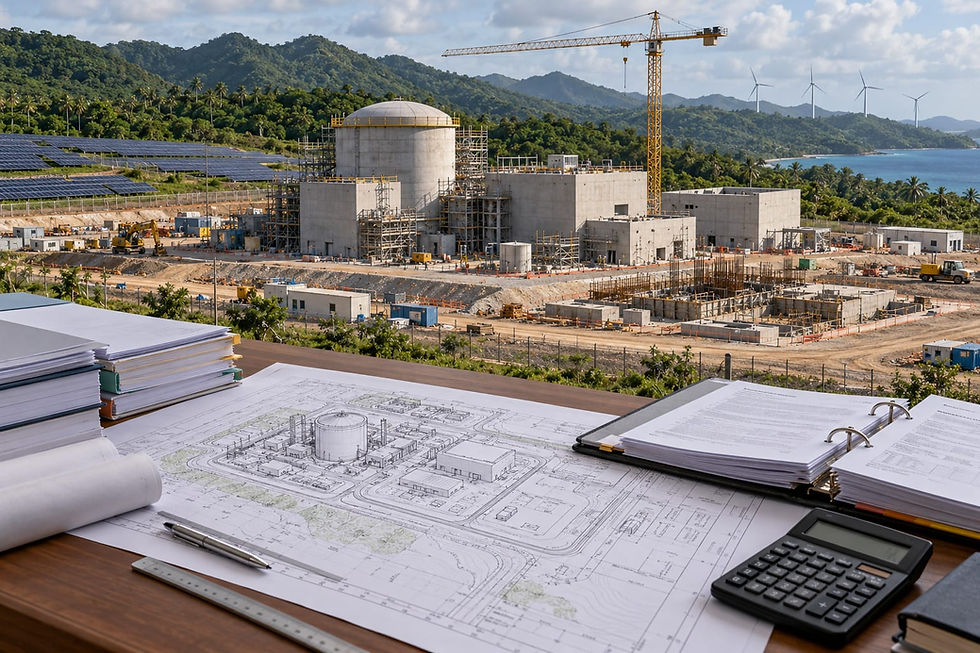
Morales Pedraza’s 2017 volume is organised around a familiar logic. It begins with a general overview of nuclear energy and advanced reactor concepts, proceeds to regional surveys of the SMR market—North America, South America, Europe, Asia—and concludes with assessments of economics, safety, proliferation, and public acceptance. The inclusion of a chapter on North and South America “including the Caribbean regions” is notable; it signals that the author intends his analysis to travel beyond the industrialised North.
The 2026 paper refines that architecture. It situates SMRs within a “green economy” framework, arguing that nuclear fission, despite its historical association with weapons proliferation and catastrophic accident, can be classified as a low-carbon technology capable of complementing renewables in a decarbonised grid. Its headline prescription is telling: “Enhance governments’ role in supporting the construction of new nuclear power reactors, particularly SMRs”.
The recommendation is not modest. It asks states to commit public capital, regulatory attention, and institutional prestige to a technology that, on the author’s own evidence, remains commercially nascent. This is not an argument for incremental research. It is an argument for state-led deployment. And deployment is precisely where the Jamaican case collapses.
The Commercial Maturity Problem
The first and most fundamental difficulty with Morales Pedraza’s advocacy is that it rests on a technology class that has not yet demonstrated what it promises. As of 2026, only a handful of SMR designs are operating commercially anywhere in the world. The most frequently cited examples—Russia’s floating KLT-40S plant and China’s HTGR-PM—are not replicable models for a small island with no nuclear supply chain, no fuel-cycle infrastructure, and no nuclear workforce.
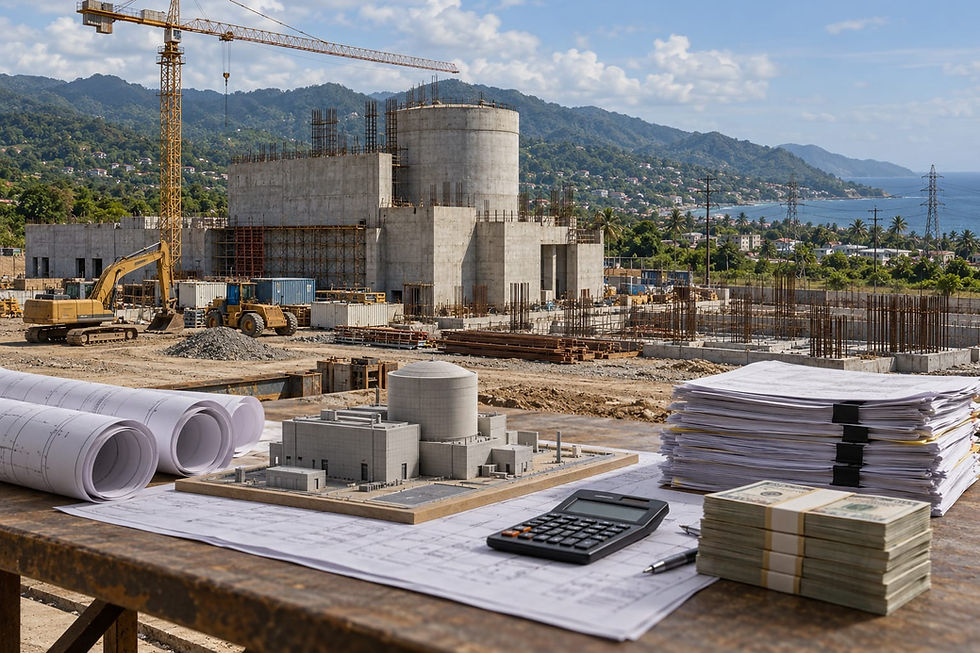
The flagship Western programme, NuScale’s UAMPS project in Idaho, was terminated in 2023 after costs more than doubled and the customer base eroded. That failure was not an aberration. It was a preview. First-of-a-kind reactors routinely exceed budget by factors of two to five, and sometimes more. The Institute for Energy Economics and Financial Analysis has documented cost escalations of three to seven times original estimates across operating and under-construction SMRs in Russia, China, and Argentina. This is not a record that encourages Jamaica to volunteer as a tropical testing ground.
Morales Pedraza acknowledges that SMRs remain pre-commercial in most markets. But he treats that immaturity as a transitional condition rather than a structural risk. For a wealthy continental utility with deep capital markets and a mature regulator, waiting for a technology to mature may be a reasonable strategy. For Jamaica—where the electricity system already struggles to finance basic transmission upgrades, where the national debt consumes a significant share of revenues, and where the ratepayer is already burdened with some of the highest tariffs in the hemisphere—pre-commercial technology is not a bridge to the future. It is a financial trap.

The Economics of Fantasy
The economics of SMRs are the crux of the matter, and Morales Pedraza’s treatment is, at best, optimistic. His 2017 book projects cost reductions through factory fabrication and learning-by-doing. His 2026 paper repeats the hope that mass production will bring SMRs into competitiveness with renewables and gas.
That hope is not evidence. It is a wager. And the evidence that exists points the other way. Lazard’s Levelized Cost of Energy analyses consistently place nuclear—both large-scale and modular—well above utility-scale solar and wind, even when storage is included. The United States Energy Information Administration’s Annual Energy Outlook projects SMR capital costs at levels that would render them uncompetitive in most markets without substantial subsidies.
More damningly, the SMR industry’s own track record suggests that learning curves are weak or absent. Nuclear construction has historically exhibited negative learning—costs rise, not fall, as experience accumulates—when projects are infrequent, designs change, supply chains fragment, and financing costs compound during delays. A small island programme would suffer all of these pathologies in acute form. There would be no fleet to achieve economies of series. There would be one reactor, or perhaps two, each bespoke, each insulated from competitive pressure.
For Jamaica, the arithmetic is stark. The country’s peak electricity demand hovers around 692 MW. A single 300 MW SMR would represent over 40 per cent of that peak. The capital cost of such a unit, on current estimates, would exceed the entire annual capital budget of the Jamaican Government. Financing it would require sovereign guarantees, long-term power-purchase obligations, and likely multilateral lending—all of which would crowd out investment in schools, hospitals, roads, and the renewable infrastructure that could actually be deployed within the decade.

The Grid Stability Problem
Morales Pedraza’s advocacy assumes that SMRs can be integrated into existing grids without destabilising them. That assumption is untenable for Jamaica.
Every electrical grid must satisfy the N−1 security criterion: it must survive the sudden loss of its largest generating unit. Jamaica’s grid, as noted, has a peak demand below 700 MW and spinning reserves of approximately 150 MW. A 300 MW reactor trip would instantaneously remove more than twice the available reserve, triggering under-frequency load shedding and potentially cascading separation. The result would not be a minor inconvenience. It would be an island-wide blackout at precisely the moment when stable power is most needed for emergency response.
The author’s regional survey chapters do not grapple with this constraint. They discuss grid integration in abstract terms—interconnection, load-following, ancillary services—without acknowledging that small, isolated island grids are categorically different from the large interconnected systems of continental Europe or North America. A 300 MW reactor in France is a manageable contingency. A 300 MW reactor in Jamaica is an existential risk.

The Seismic Question
Perhaps the most egregious omission in Morales Pedraza’s treatment of the Caribbean is the seismic question. Jamaica sits astride the Enriquillo–Plantain Garden fault system, a tectonically active boundary capable of generating magnitude 7.0 or greater earthquakes. Probabilistic seismic hazard analyses establish a baseline peak ground acceleration of 0.30g to 0.40g in eastern parishes. The 2010 Haiti earthquake, which killed over 200,000 people, occurred on the same fault system.
Nuclear reactors can be engineered for seismic resilience. But the engineering is extraordinarily demanding. It requires site-specific fault investigations, paleoseismological trenching, liquefaction assessments, and containment designs that can withstand ground motions far beyond conventional building codes. These studies take years, not months. They require expertise that Jamaica does not possess and would have to import at enormous cost. And even then, the residual risk cannot be eliminated. It can only be minimised.
Morales Pedraza does not address this in his Caribbean analysis. He treats the region as a generic market opportunity, not as a specific geological hazard zone. That is a serious scholarly failure. A book that purports to assess SMR prospects for the Caribbean cannot ignore the fact that the Caribbean is one of the most seismically active regions on Earth.

The Institutional Readiness Gap
The International Atomic Energy Agency’s Milestones Approach identifies nineteen infrastructure issues that a newcomer nuclear state must address before commissioning a reactor. These include national policy, legal framework, regulatory body, financing, safeguards, security, emergency planning, radioactive waste management, and human-resource development. The IAEA estimates that a conventional newcomer programme takes ten to fifteen years to complete.
Morales Pedraza acknowledges that institutional readiness is a prerequisite. But he does not confront the depth of the challenge for a country like Jamaica. The Hazardous Substances Regulatory Authority, which would be the nuclear regulator, currently oversees medical and industrial radioactive sources, not power reactors. It lacks the staff, the statutory authority, and the technical capacity to license a nuclear power plant. Building that capacity would require decades of training, significant international assistance, and sustained political commitment across multiple administrations.
The author’s prescription—enhance governments’ role—is precisely backwards. The problem is not that governments are insufficiently involved. The problem is that governments are being asked to assume responsibilities they cannot discharge. A nuclear programme demands a regulatory culture of relentless independence, technical depth, and enforcement. Jamaica’s regulatory culture, across multiple sectors, does not yet meet that standard. Pretending otherwise is not advocacy; it is denial.

The Waste Problem
Morales Pedraza discusses radioactive waste management in general terms, noting that SMRs produce less waste per unit of electricity than large reactors and that geological disposal is technically feasible. Both claims are true in the abstract. Neither addresses Jamaica’s specific circumstances.
There is no geological disposal facility anywhere in the Caribbean. There is no regional agreement on spent-fuel management. There is no pathway for exporting high-level waste to a willing recipient, because no major nuclear state currently accepts foreign waste for permanent disposal. If Jamaica operated an SMR, spent fuel would remain on the island indefinitely, secured against hurricanes, earthquakes, and human error, for centuries.
The author does not confront this. He does not ask where the waste would go, who would pay for its storage, or what happens if the operator goes bankrupt. These are not hypothetical concerns. They are the ordinary realities of nuclear stewardship, and they are precisely the questions that a small island state cannot answer.

The Opportunity Cost
Perhaps the most serious omission in Morales Pedraza’s analysis is the opportunity cost of nuclear investment. Every dollar committed to an SMR is a dollar not committed to solar, wind, battery storage, grid modernisation, energy efficiency, or demand management. The author treats SMRs as complementary to renewables. In Jamaica’s fiscal reality, they are competitive.
The evidence from comparable small states is instructive. Uruguay has achieved 98 per cent renewable electricity without a single nuclear reactor. Costa Rica routinely operates on near-100 per cent renewables. Barbados, Jamaica’s CARICOM neighbour, has set ambitious renewable targets without nuclear ambitions. These countries have demonstrated that the path to energy sovereignty does not require fission.
Morales Pedraza does not engage with these cases. His regional survey chapters discuss SMR market potential, not comparative alternatives. That is a methodological choice, but it is also a rhetorical one. By framing the question as “how can SMRs be deployed?” rather than “are SMRs the best use of scarce capital?”, he forecloses the most important policy question.
The Safety Culture Question
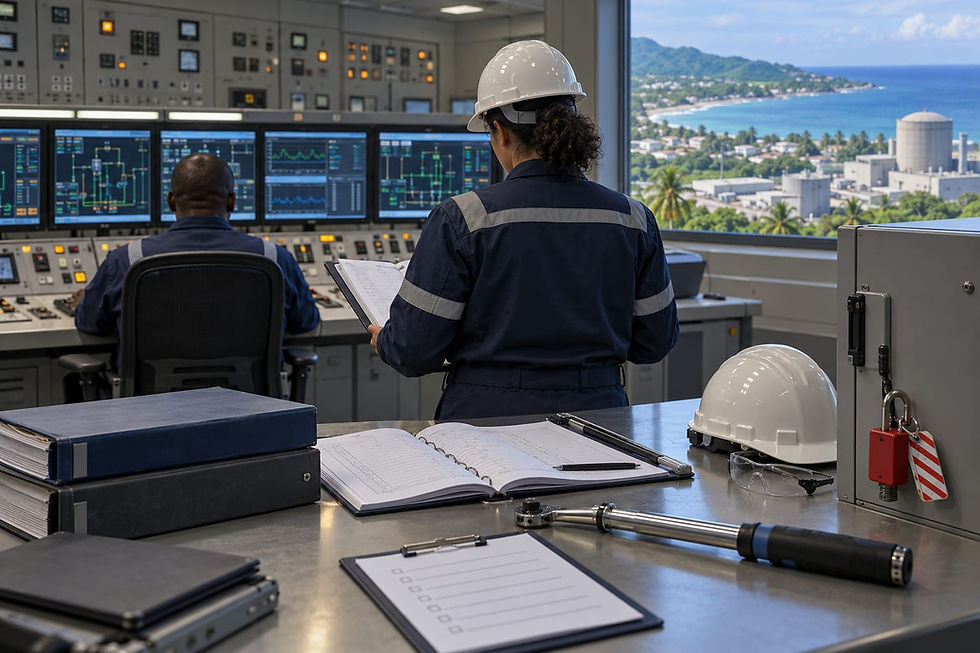
Nuclear safety is not primarily a matter of engineering. It is a matter of culture. The Fukushima disaster was not caused by a failure of reactor design; it was caused by a failure of regulatory oversight, operator complacency, and a cultural unwillingness to challenge assumptions. The Chornobyl disaster was similarly rooted in institutional dysfunction.
Morales Pedraza acknowledges the importance of safety culture. But he does not ask whether Jamaica possesses it. The answer, on the evidence, is no. Jamaica’s record in managing complex industrial facilities—bauxite refineries, water treatment plants, public hospitals—is uneven. Maintenance is deferred. Inspections are irregular. Political interference is common. These are not the conditions under which nuclear power can be safely operated.
A nuclear reactor is not a hospital or a refinery. It is a machine that can render a large portion of a small island uninhabitable if it fails. The tolerance for error is vanishingly small. Jamaica does not have the institutional margin for that tolerance.
The Democratic Deficit
Finally, there is the question of democratic consent. Nuclear power is a multigenerational commitment. It imposes obligations on citizens who have not yet been born. It requires a level of public trust that Jamaica’s political culture does not currently sustain.
Morales Pedraza does not address the democratic dimension. He treats nuclear deployment as a technocratic problem to be solved by experts and financed by governments. But in a democracy, the decision to embrace nuclear power is not merely technical. It is political, moral, and intergenerational. It requires informed consent, transparent debate, and a willingness to accept the possibility of catastrophic failure.
Jamaica has not had that debate. The Government has signed memoranda of understanding, convened committees, and made pronouncements. It has not published a comparative cost-benefit analysis, a seismic risk assessment, a waste management plan, or a regulatory roadmap. It has not asked the public whether they wish to accept the risks. It has not asked the ratepayer whether they are prepared to pay the costs.
That is not governance. It is imposition.

Conclusion: The Scholar’s Blind Spot
Jorge Morales Pedraza has written a useful survey of a technology class that may, in some jurisdictions, contribute to decarbonisation. His work deserves to be read by energy planners, regulators, and scholars. But it should not be read as a blueprint for Jamaica.
The blind spot in his analysis is not technical. It is contextual. He writes as a nuclear advocate addressing a generic audience, and his prescriptions reflect that orientation. He does not grapple with the specific constraints that make SMRs unsuitable for a small, seismic, debt-constrained, institutionally fragile island state. He does not ask whether Jamaica can afford nuclear power, whether it can regulate it, whether it can secure it, whether it can manage its waste, or whether it can survive its failure.
Those questions are not peripheral. They are the heart of the matter. And on those questions, Morales Pedraza is silent.
Jamaica’s energy future must be built on technologies that are available now, affordable now, and deployable now. Solar, wind, biomass, hydro, battery storage, grid modernisation, and energy efficiency are not consolation prizes. They are the foundation of a resilient, sovereign, and democratic energy system. They can be installed incrementally, diversified geographically, and scaled without committing the nation to a single technological monopoly.
SMRs offer no such flexibility. They offer a single, centralised, capital-intensive, seismically vulnerable, and institutionally demanding gamble. That gamble is not worth taking. And no amount of scholarly advocacy can change the arithmetic of an island’s geography, its grid, its treasury, or its history.
Morales Pedraza has written a book about what SMRs might become. Jamaica needs a policy about what Jamaica can actually do. The two are not the same.


Comments