%202021_edited_edited.jpg)


Gravy, Sauce, and the Politics of Billioneering

In Jamaica, we do not joke about food.
We may quarrel about politics, football, even Scripture—but when it comes to what is placed on a plate, Jamaicans possess a finely tuned, almost sacred instinct. We know when something “cook down right.” We know when the seasoning reach. And we most certainly know the difference between gravy and sauce.
Gravy is truth.

Gravy comes from the cooking itself—the slow release of flavour under heat, the honest consequence of time, patience, and craft. It is the molecular residue of substance, the brown, sticky evidence of a pot that has endured the fire. It cannot be hurried by a high flame, nor can it be convincingly faked by a heavy hand with the browning. It is an organic byproduct of the struggle between the meat and the flame.
Sauce, however, is performance.
Sauce can be poured on at the end—thick, glossy, persuasive. It is a manufactured additive, a chemical or culinary shortcut designed to coat deficiencies, disguise the dryness of a rushed bird, and lend the illusion of richness to what, underneath, remains thin and unyielding. Sauce is not inherently dishonest in a vacuum—but it becomes a tool of deception when it pretends to be the essence of the meal.
And this, I submit, is the central political economy of modern Jamaica.
We are being governed, increasingly, by sauce.
The Theatre of the Ladle
Listen carefully to the national conversation. The cadence is unmistakable. We hear of "Best in The Caribbean" accolades, “Transformational Giga-projects,” and “World-class infrastructure.” Each phrase arrives like a ladle of well-seasoned rhetoric, poured generously over the public imagination to ensure the plate looks modern, glistening, and ready for a digital photograph.
But ask a simpler question—one that any grandmother in Portland, St Mary, or Clarendon would understand as she lifts a pot cover: Where is the gravy?
Where is the deep, sustaining substance that should accompany all this apparent richness?
Because when one looks beneath the glossy surface—past the high-definition press conferences, the choreographed ribbon-cuttings, and the sweeping drone-shot panoramas of new asphalt—an uncomfortable, jagged pattern emerges. Too many Jamaicans are still navigating the treacherous terrain of underfunded schools, overstretched hospitals, precarious "gig" employment, and a cost of living that quietly, relentlessly erodes the very foundations of human dignity.
The plate looks full in the brochure. But the nourishment on the ground is tragically uneven.
The Rise of Billioneering
This is not accidental. It is structural. It is what I have called, without apology, the age of Jamaican billioneering.
Billioneering is not merely about the extraction of wealth. It is about the theatrical display of wealth—its amplification, its projection, and its eventual conversion into political currency. It is the high art of appearing abundantly resourced and "investable" while the underlying social systems remain fragile, underdeveloped, or deliberately opaque. It is a governance style that prioritises the "Look" of the First World while the "Feel" remains stubbornly stuck in the Third.
In a billioneering state, sauce is essential.
Optics must be maintained at a fever pitch. Narratives must be managed with the precision of a corporate rebrand. The appearance of forward motion must never—ever—be interrupted by the slower, less glamorous, and decidedly un-photogenic work of institutional strengthening. And so, the announcements multiply. Figures are cited with a dizzying, technocratic speed. Public-private partnerships are unveiled like new fashion lines. Yet the translation of these "wins" into lived, measurable, and equitable outcomes for the man at the stoplight remains… uneven.
Or, to return to the kitchen: the pot is making a hell of a noise, but the meat is still tough.
The Masquerade of the Macro
Now let us be clear. No serious observer denies that Jamaica has made strides in certain macroeconomic indicators. Our debt-to-GDP ratios and primary surpluses are the envy of many a developing nation. Nor should we trivialise genuine efforts at reform. But macroeconomic polish, without microeconomic nourishment, is precisely how sauce begins to masquerade as gravy.
When the "Stability" of the state does not translate into the "Security" of the citizen, the sauce has curdled.
And Jamaicans, if we are honest, are not easily fooled forever. We possess a "bad-mind" for falseness that is actually a sophisticated defense mechanism. We see it in the quiet, bone-deep cynicism of the peanut vendor. We hear it in the guarded, weary tone of the teacher marking papers by candlelight. We feel it in the frantic calculation of the nurse deciding which utility bill can wait another week. There is a growing recognition—often unspoken in the halls of power, but shouted in the shared taxis—that something is not quite adding up.
The country looks better on a spreadsheet than it feels in a shopping basket.
The Cost of Symbolism
That dissonance is dangerous. It breeds a peculiar kind of national rot.
Because a society that is persistently served sauce in place of gravy undergoes a subtle but profound psychological shift. Its expectations lower. Its appetite for actual substance diminishes. It becomes acclimatised to presentation over performance, to symbolism over delivery. We begin to celebrate the "Announcement" of the hospital wing rather than the "Presence" of the medicine within it.
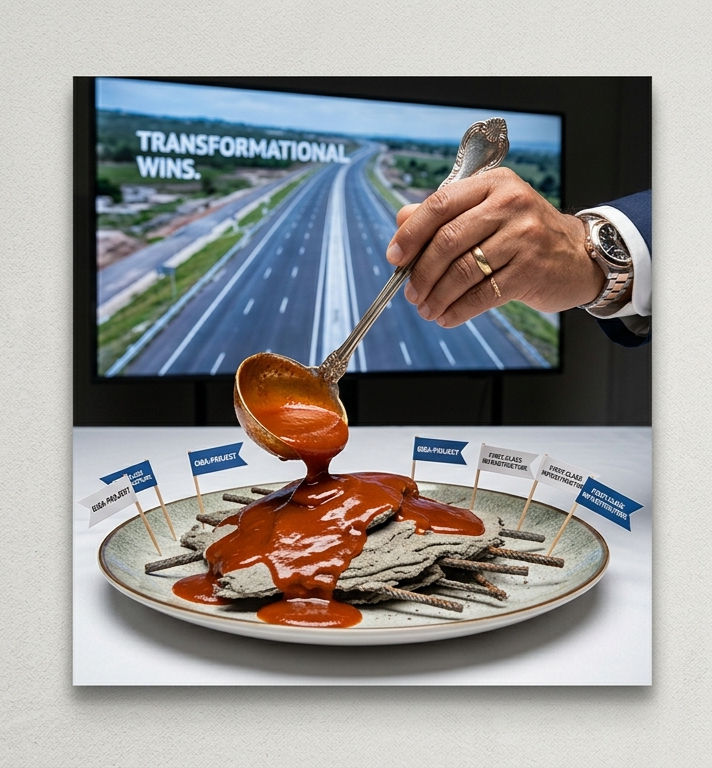
This is how decline hides in plain sight. Not through spectacular, cinematic collapse, but through a gradual, quiet substitution—where citizens are trained, over time, to accept the garnish as the meal.
And here, the role of leadership becomes critical.
This is not a time for the "hero minister," no matter how eloquent, social-media savvy, or energetic. The challenges Jamaica faces—the energy transition, a foundational education crisis, healthcare resilience, and the desperate need for economic diversification—are too complex, too interdependent, and too unforgiving of ego-driven governance.
The Call for the Slow Cook
These issues require something far less photogenic and far more demanding: disciplined, evidence-based, multidisciplinary coordination. They require "systems thinking"—the ability to see the pot, the fire, and the ingredients as a single, breathing entity. They require transparency that goes beyond quarterly sound bites and slick infographics. Above all, they require a political willingness to prioritise the long-term gravy of institutional health over the short-term sauce of the news cycle.
But billioneering resists such discipline.
Billioneering thrives on immediacy, on spectacle, on the rapid conversion of a "Memorandum of Understanding" into a round of applause. It is fundamentally uncomfortable with the slow, iterative, often invisible work that produces real institutional depth. It prefers the microwave to the Dutchie. And so, the temptation persists—to plate quickly, to garnish heavily with "Tufton-heavy" sauce 2.3, and to move on to the next photo-op before the question of actual substance becomes unavoidable.
The Sovereignty of the Plate
Yet Jamaicans, I repeat, know food.
We know when a stew has been allowed to settle into itself, when the flavours have married properly, and when the gravy holds—not watery, not forced, but earned through fire. That cultural intelligence, that "yam-head" wisdom, must now be redeployed in our civic life.
We must begin, collectively, to interrogate what is being served at the Cabinet table.
When a multi-billion dollar project is announced, we must ask: What is its long-term yield for the un-pensioned? Who benefits, concretely, once the cameras are packed away? What systems support it when the "hero" moves on? How resilient is it under the stress of a hurricane or a global shift? When numbers are cited, we must demand to know what they mean at the level of the household, the classroom, and the rural clinic.
Jamaica cannot afford the luxury of illusion.
We stand at a point of immense possibility—new resources, emerging technologies, and new global alignments are within our reach. But possibility, like raw ingredients sitting on a counter, is not enough to satisfy a hungry nation. It must be transformed, carefully and honestly, into something that can sustain a people for generations.
That transformation cannot be rushed. It cannot be "sauced" into existence. It must be cooked—properly, patiently, and with an unswerving integrity that respects the fire.
So let us return to the simplest wisdom we possess. When the pot is opened and the steam rises, do not be distracted by the shine of the ladle or the garnish on the rim.
Look for the gravy.
Ensure—by vigilance, by voice, and by a stubborn refusal to be pacified by presentation—that when Jamaica is served, it is not merely dressed to impress, but prepared to nourish. Because in the end, a state, like a meal, must do more than look good on an Instagram feed.
It must feed its people. It must stick to the ribs. It must be true.
by Dennis A. Minott, PhD.
April 18, 2026.


Comments