%202021_edited_edited.jpg)


When Our Cabinet Models Ingratitude, Jamaicans Learn


A nation does not drift into moral confusion by accident. It is taught—patiently, repeatedly—by those who govern it.
In Jamaica, the Cabinet is not merely an administrative body. It is the country’s most powerful instructor of values. And what it has been teaching, with chilling consistency, is this: memory is expendable, loyalty is naïve, and service is for fools.
A government that models ingratitude trains a people to practise it.
What we are witnessing is not episodic misjudgement. It is a pattern—systemic, replicable, and corrosive—where past kindness is discounted the moment it becomes inconvenient, and indispensable labour is treated as an infinitely renewable resource.
The International Theatre: Strategic Amnesia
Let us begin where the signals are loudest.
For nearly two decades, Venezuela’s Petrocaribe arrangement functioned as an economic shock absorber for Jamaica. It allowed oil to be purchased on concessionary terms, with deferred payments that freed fiscal space for development. Across the Caribbean, Petrocaribe financing ran into billions of US dollars, with Jamaica among its principal beneficiaries.
This was not charity. But neither was it ordinary commerce. It was solidarity underwritten by trust.
And yet, when geopolitical pressure mounted, that trust was treated as disposable. Venezuela’s 49 per cent stake in Petrojam, a cornerstone of Jamaica’s energy infrastructure, was forcibly reclaimed under the language of necessity. Legal arguments were advanced; geopolitical realities were invoked. But the deeper signal was unmistakable: yesterday’s partner can become today’s inconvenience.
The Cuban example cuts even deeper.
For over half a century, Cuban medical professionals have helped sustain Jamaica’s healthcare system, especially in rural and underserved communities. Up to last month, hundreds of Cuban doctors and nurses served across this island, filling gaps that domestic capacity cannot.
And yet, under pressure from Washington—particularly under the Trump-Rubio iron-dome—Jamaica recalibrated its posture. The long arc of medical solidarity bent suddenly toward diplomatic suck-up. Decades of service were quietly discounted in the pursuit of external approval.
No state is free from geopolitical constraint. But constraint does not require ingratitude. That is a choice.
The Domestic Mirror: Economic Ingratitude as Policy
If the Cabinet rehearses ingratitude abroad, it institutionalises it at home.
Educators: Builders Paid Like Afterthoughts
Jamaican teachers, entrusted with shaping the intellectual future of the nation, remain undercompensated relative to their regional peers. In comparative terms, starting salaries in Jamaica lag well behind those in Trinidad, Antigua, and Barbados, even after recent adjustments that have been eroded by inflation.
We praise teachers rhetorically and neglect them materially. The contradiction is no longer subtle.
The Scandal of the Unpaid Mind
But there is a quieter scandal—one that exposes the moral economy of the state even more starkly.
In Jamaica’s traditional media, many of the country’s most consistent and thoughtful commentators are paid nothing at all. Not poorly—nothing.
Week after week, they produce essays of analysis, critique, and nation-building reflection. They sharpen public discourse. They challenge power. They educate the citizenry. And they do so without monetary compensation, sustained only by civic duty and personal sacrifice.
This is not an industry oversight. It is a structural exploitation of intellectual labour—one that signals, unmistakably, that thinking, writing, and public reasoning are not worthy of remuneration.
A society that refuses to pay its thinkers should not be surprised when thinking becomes scarce.
Christian Full-Time Workers: Moral Labour, Material Neglect
Then there are the Christian full-time workers—the pastors, missionaries, youth leaders, and ministry staff who quietly stabilise communities the state cannot reach.
In a country where over 70 per cent of the population identifies as Christian, these workers provide counselling, conflict mediation, youth mentorship, and social cohesion. They absorb grief, defuse violence, and rebuild families.
And how are they compensated?
Often through stipends rather than salaries, with little or no pension security, minimal health coverage, and no structured income progression. Many live precariously, even as they sustain others.
The irony is as cruel as it is revealing: those tasked with nurturing the nation’s moral core are themselves economically marginalised.
Frontline Jamaica: Applause Without Justice
Across the broader economy, the pattern repeats with numbing consistency:
Nurses: Jamaica continues to experience significant out-migration of trained nurses, with thousands leaving over the past decade for better-paying systems abroad.
Police officers: Risk is high; remuneration remains comparatively modest.
Tourism workers: An industry contributing roughly 30–35 per cent of GDP (direct and indirect) rests on workers whose wages often require supplementation through tips.
BPO employees: Over 50,000 Jamaicans are employed in the sector, yet many earn wages that barely track the cost of living, even as firms benefit from generous state concessions.
From pulpits to classrooms, from clinics to call centres, the message is relentless: your labour is essential, but you are not.
What the Nation Learns
And so the lesson is learned.
Not in textbooks, but in lived experience.
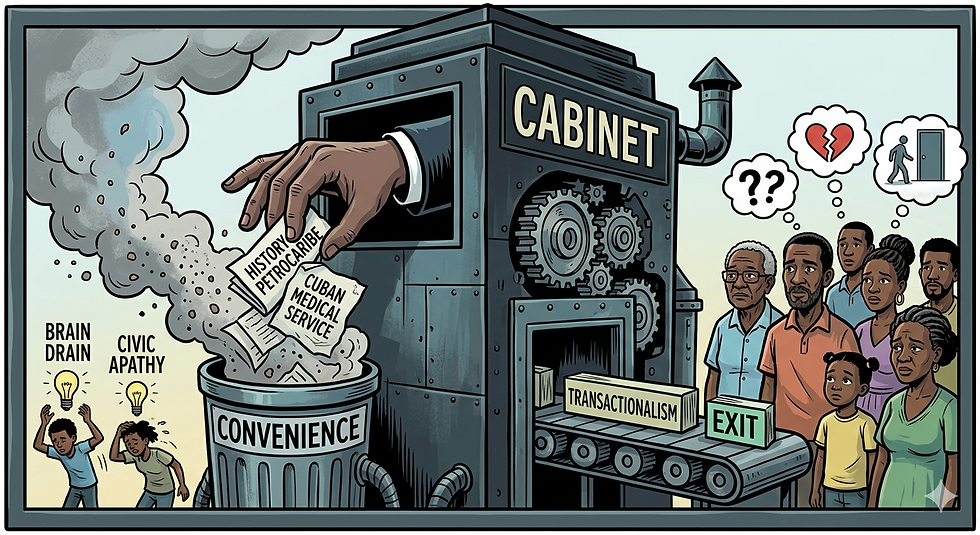
Young Jamaicans observe a state that discards long-standing allies when convenient and underpays—or refuses to pay—those who sustain its daily functioning. They draw the obvious conclusion:
Loyalty is irrational. Service is exploitation. Memory is optional.
The consequences are already upon us:
Persistent "brain drain", hollowing out critical sectors
Expanding civic apathy, especially among the young
A hardening culture of transactionalism, where commitment is conditional and trust is scarce
When a government models ingratitude, it should not be surprised when citizens reciprocate with indifference—or exit.
A Nation at Risk of Forgetting Itself
Leadership is not merely about managing systems. It is about shaping behaviour.
To model gratitude is not sentimental—it is strategic. It builds durable alliances, stabilises institutions, and signals that contribution will be honoured, not exploited.
That requires two acts of courage:
To remember—even when memory is inconvenient
To compensate justly—even when budgets are tight
Until those acts become visible in both diplomacy and domestic policy, Jamaica will continue to absorb a dangerous civic lesson:
That loyalty is foolish, gratitude is weakness, and the wise response to one’s country is not commitment—but escape.
And a nation that teaches that lesson too well will, in time, discover that it has educated its best people to leave—and its remaining citizens to care less.

by Dennis A Minott. PhD.
April 12, 2026


Comments