%202021_edited_edited.jpg)


The Architecture of Opacity: Why Caribbean Educational Accountability is a Bureaucratic Myth

In the urgent public debate over educational accountability across Jamaica and the wider Caribbean Community (CARICOM), a vital public service has been performed by commentator Christopher McCurdy. By insisting that institutional responsibility cannot remain an optional luxury within our school system, his public interventions point directly at a gaping wound in our national development strategy. He is entirely correct. Yet, if we are to move beyond mere diagnosis and engineer a cure, we must recognise that this crisis goes far deeper than administrative lethargy, structural inertia, or the routine underperformance of successive political administrations.
The structural rot at the core of our educational architecture is systemic opacity. Jamaica and its regional neighbours still completely lack a coherent, standardised, and internationally intelligible system for measuring, verifying, and reporting student academic outcomes across schools, grades, and subjects.
Accountability in education cannot merely be proclaimed rhetorically; it must be measurable, transparent, internationally benchmarked, and institutionally enforceable. The deeper regional scandal is that thousands of capable Caribbean children continue to pass through educational structures whose academic reporting cultures remain fragmented, inconsistent, and frequently resistant to external scrutiny. This reality carries profound consequences not merely for students, but also for teachers, universities, employers, policymakers, researchers, and ultimately the developmental future of our societies.
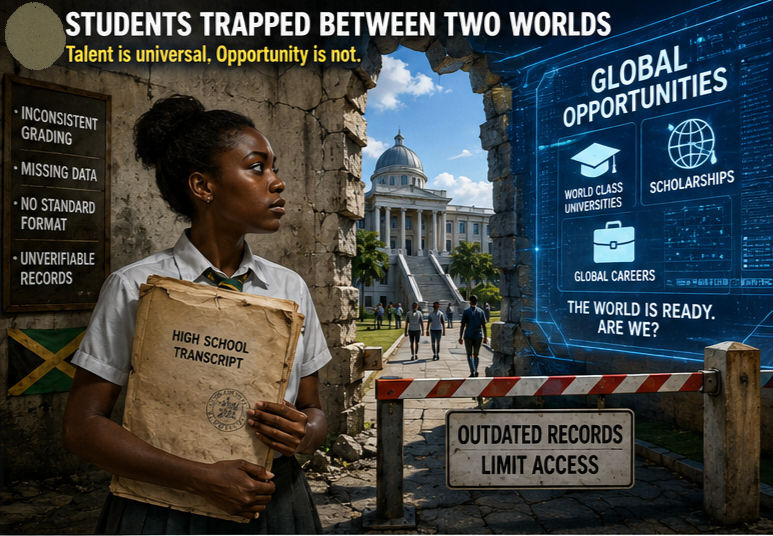
A Rag-Tag Patchwork of Academic Records
To look closely at the secondary school landscape across CARICOM today is to confront a bewildering, rag-tag patchwork of reporting formats. Some high schools issue detailed percentage breakdowns; others rely on opaque, subjective letter grades divorced from any national rubric. Many still depend on vague, handwritten or poorly formatted transcript narratives that read more like sentimental character references than rigorous academic audits.
Data retention standards are similarly uneven. Critical student records are frequently lost to shifting school leadership, poorly managed local servers, or literal filing cabinet decay. This is not merely untidy administration. It is structural unfairness disguised as educational normalcy, acting as an institutional shield that protects inefficiency, masks pedagogical failure, and leaves the public entirely in the dark about what is actually happening behind school gates.
A brilliant student from rural Portland or St Mary in Jamaica, or from the communities of St Lucia, Dominica, Tobago, Guyana, and Belize, should not be structurally disadvantaged because their school lacks an internationally intelligible transcript architecture. Nor should hardworking teachers remain professionally invisible within opaque systems where neither student growth nor instructional effectiveness can be properly evaluated over time.
The modern world runs increasingly on reliable data, and education is no exception. In advanced educational systems, every course taught generates measurable records tied to clearly defined competencies, grading distributions, attendance patterns, progression rates, and longitudinal student outcomes. Universities and employers increasingly expect transcripts that reveal not merely isolated examination grades, but also the precise academic context within which those grades were earned.
What percentage of students succeeded? How rigorous was the course? How did this student perform relative to cohort peers? Did the school demonstrate sustained year-on-year improvement? What empirical evidence exists of instructional effectiveness? Too often, Caribbean educational systems cannot answer such questions with confidence.
Instead, we tolerate a culture where grades appear inflated without meaningful standardisation, records remain partially paper-based and vulnerable to manipulation or prolonged delay, and transcript preparation depends excessively upon the diligence or competence of a single, overwhelmed administrator. That is unacceptable in 2026.
Groping in the Policy Dark
Worse still, the absence of integrated regional educational clearinghouses means that Caribbean policymakers frequently operate with astonishingly weak longitudinal educational intelligence. Ministries attempt grand structural reforms while lacking granular datasets capable of revealing where deterioration, stagnation, or genuine improvement actually occur. We endlessly debate educational decline while possessing inadequate systems for measuring it precisely.
Suppose a ministry wished to identify which mathematics departments consistently generate strong student progression despite modest financial resources. Could the existing data systems determine that reliably? Suppose researchers wished to compare literacy growth patterns across urban and rural cohorts over a decade. Does the regional data architecture adequately support such analysis? Suppose employers wished rapidly to verify the authenticity and academic reliability of transcripts. Can they consistently do so? Too often, the answer remains an embarrassing no.
Meanwhile, the global educational marketplace grows steadily more sophisticated. American universities now routinely deploy advanced contextual admissions analytics. British institutions increasingly examine school profiles and transcript consistency. Scholarship agencies scrutinise longitudinal academic trends, and employers assess not merely credentials, but institutional credibility itself.
In that environment, Caribbean students are forced to compete internationally while carrying academic documentation systems rooted administratively in another era. Outstanding talent is obscured by poor documentation. Our youth are effectively locked out of global mobility, not because they lack intellectual or analytical capacity, but because their country’s educational infrastructure fails to present their achievements in a universally recognised academic currency.
The solution requires a radical, legislative departure from status-quo complacency. Every single high school course taught across the length and breadth of Jamaica and the wider Caribbean must be mandated to generate clearly structured, immutable digital records. These records cannot simply show an isolated end-of-term grade. They must capture comprehensive, measurable student outcomes: cohort performance distributions, year-over-year progression rates, and granulated metrics that reflect teaching effectiveness across specific subject areas.
Crucially, these data points must not be left to rot on isolated school hard drives. They must be systematically ingested into a centralised, secure national educational clearinghouse. This repository must be governed not by polite ministerial suggestions, but by legally enforceable reporting deadlines, strict data protection protocols, and unyielding quality standards.

The Fear of External Benchmarking
Yet another uncomfortable dimension lurks beneath this discussion—one Caribbean policymakers rarely confront openly. The global educational environment is steadily migrating toward externally benchmarked assessment systems capable not merely of evaluating students, but also of exposing the comparative effectiveness of schools, districts, curricula, teacher-training institutions, and ministries of education themselves.
That reality partly explains the growing international significance of the ACT examination system. Unlike the older aptitude-oriented philosophy historically associated with the College Board SAT, the ACT framework aligns more closely with curriculum-grounded assessment models resembling competencies embedded within Common Core approaches. Increasingly, the ACT functions not merely as a university admissions instrument, but as a broad secondary-school performance metric capable of generating internationally comparable educational evidence.
Because the ACT is administered repeatedly across multiple jurisdictions worldwide, it quietly creates something many regional governments publicly claim to desire but often appear reluctant genuinely to permit: externally benchmarked longitudinal educational data. Such data can reveal whether students in a given system are genuinely improving in literacy, mathematics, scientific reasoning, and analytical writing relative to global peers. It can expose curriculum weaknesses, identify effective schools operating under difficult circumstances, and illuminate chronic underperformance hidden beneath inflated local grading cultures and institutional prestige.
And precisely there lies the political sensitivity. Across portions of CARICOM, one senses a deep institutional discomfort regarding rigorous external benchmarking systems such as the Programme for International Student Assessment (PISA) or widespread ACT implementation. Publicly, objections are routinely framed around cultural relevance, curriculum sovereignty, or fiscal cost. Yet privately, another anxiety exists beneath the surface: genuine comparability invites unsparing scrutiny.

Once internationally benchmarked data enters the public domain, educational mythology becomes impossible to sustain. Weak literacy rates can no longer hide behind patriotic speeches or theatrical graduation ceremonies. Inflated internal grades lose their protective value. Ministries become measurable, teacher-training systems become comparable, and school effectiveness becomes visible to the taxpayer.
In that context, an unspoken bureaucratic instinct quietly emerges: protect the status quo, avoid PISA, and resist the scrutiny of the ACT. For without such external reference points, entire educational systems may continue operating semi-independently, insulated from the uncomfortable discipline of transparent international comparison.
Dismantling the Shield
But such insulation comes at a terrible cost to Caribbean children. The world our students now enter is brutally comparative, globally networked, technologically driven, and relentlessly data-oriented. Shielding educational systems from rigorous measurement does not protect our students; it fundamentally weakens their competitiveness while preserving bureaucratic comfort.
The cost of maintaining our current, fragmented status quo is catastrophic. Without reliable, longitudinal educational data, our national policymakers are left to grope blindly in the dark, designing multi-million-dollar interventions based on institutional vibes rather than empirical reality. Independent researchers are reduced to mere speculation, unable to track student trajectories from early childhood through to tertiary output. Local and regional employers are forced to treat high school transcripts with deep mistrust, turning to expensive, repetitive internal testing just to verify basic literacy and numeracy among applicants. Universities, meanwhile, are left struggling to fairly evaluate the true merit of student portfolios, leaving admissions vulnerable to institutional bias and legacy prestige.

A serious educational civilisation does not fear measurement. It welcomes it because measurement permits targeted improvement. Indeed, one of the great paradoxes of Caribbean educational discourse is that societies which routinely celebrate academic excellence often resist the very forms of transparent benchmarking capable of validating and strengthening that excellence internationally.
That contradiction cannot endure indefinitely. If Jamaica and the wider CARICOM region genuinely aspire toward first-world educational standards, then we must once and for all abandon third-world informational architectures. We cannot continue speaking grandly about "world-class education" while maintaining transcript systems, data cultures, and accountability structures that frequently fail world-class scrutiny.
Christopher McCurdy is entirely correct: accountability cannot remain optional. But accountability without measurable, transparent, and internationally intelligible standards quickly degenerates into empty political rhetoric. It becomes a theatrical exercise of press releases, circular arguments, and circular blame.
If we truly believe that education is the primary engine of Jamaican and Caribbean development, we must build a national information infrastructure that reflects that belief. We must provide our students with the transparent, globally legible credentials they need to compete on the world stage, while giving our taxpayers the rigorous data they require to hold academic institutions accountable. Rhetoric, however eloquent, has never yet prepared a transcript, guided a policymaker, admitted a student, strengthened a ministry, or built a modern nation. It is time to mandate international standards.
Thank you for the benefit of your time.
Regards,
Dennis A. Minott, A-Q
Dennis A. Minott, PhD, is a physicist, green energy consultant, and long-time college counsellor. He is the CEO of A-QuEST University/College Counselling Online JA.
May 21, 2026.


Comments