%202021_edited_edited.jpg)


The Composite Animal Jamaica Is Quietly Creating


I must confess that I increasingly worry that Jamaicans are looking at Prime Minister Andrew Holness incorrectly. We keep debating him as though he were a conventional political figure who can be understood through ordinary partisan categories: JLP versus PNP, conservative versus progressive, competent versus incompetent, moderniser versus populist. That may now be a dangerous analytical mistake.
What Jamaica may instead be witnessing is the gradual emergence of a composite political animal.
Not a dictator in the old Caribbean style. Not a crude strongman. Not even a simple autocrat. Those labels are too primitive for the political architecture now taking shape before our eyes. The modern democratic age rarely produces naked tyrants. What it increasingly generates are hybrid creatures: leaders who retain elections, speak the language of efficiency, market themselves as modernisers, cultivate corporate confidence, and simultaneously weaken the moral, institutional, and psychological foundations of accountability.
That is the danger.
The alarming feature is not any single controversy. Democracies can survive scandals. Democracies can survive errors. Democracies can even survive occasional corruption. What they struggle to survive is the normalisation of a governing culture in which oversight bodies become irritants, transparency becomes negotiable, and political loyalty gradually supersedes institutional restraint.
That is how composite animals evolve.
The first visible component is technocratic polish. Holness projects calm managerialism exceptionally well. He speaks the language of growth metrics, logistics hubs, digital transformation, resilience, investment confidence, and infrastructure modernisation. International investors generally prefer this vocabulary to the old Caribbean theatrical populism. The presentation is disciplined, polished, and globally marketable.
But polished presentation is not itself democratic virtue.
Indeed, some of the most durable democratic erosions worldwide have emerged not from chaotic demagogues but from highly disciplined political managers who learned how to centralise authority quietly while preserving the outward rituals of democracy.
The second component is executive impatience with scrutiny.
When serious questions emerged concerning statutory declarations, unexplained financial discrepancies, jointly held accounts, and large transactional irregularities identified by the Integrity Commission, Jamaicans should have witnessed an overwhelming demonstration of transparency. Instead, the public largely observed defensiveness, legal manoeuvring, political counterattacks, and efforts to discredit or neutralise institutional criticism.
That matters enormously.
The health of a democracy is not measured by whether leaders are accused. Every leader eventually will be. The real test is how leadership responds when independent institutions raise uncomfortable questions.
Do leaders invite sunlight?
Or do they begin treating oversight as hostile warfare?
South Africans learned this lesson painfully during the long deterioration under Jacob Zuma. The tragedy of the Zuma years did not begin with spectacular collapse. It began gradually. Piece by piece. Appointment by appointment. Excuse by excuse. Institutional exhaustion arrived before institutional collapse.
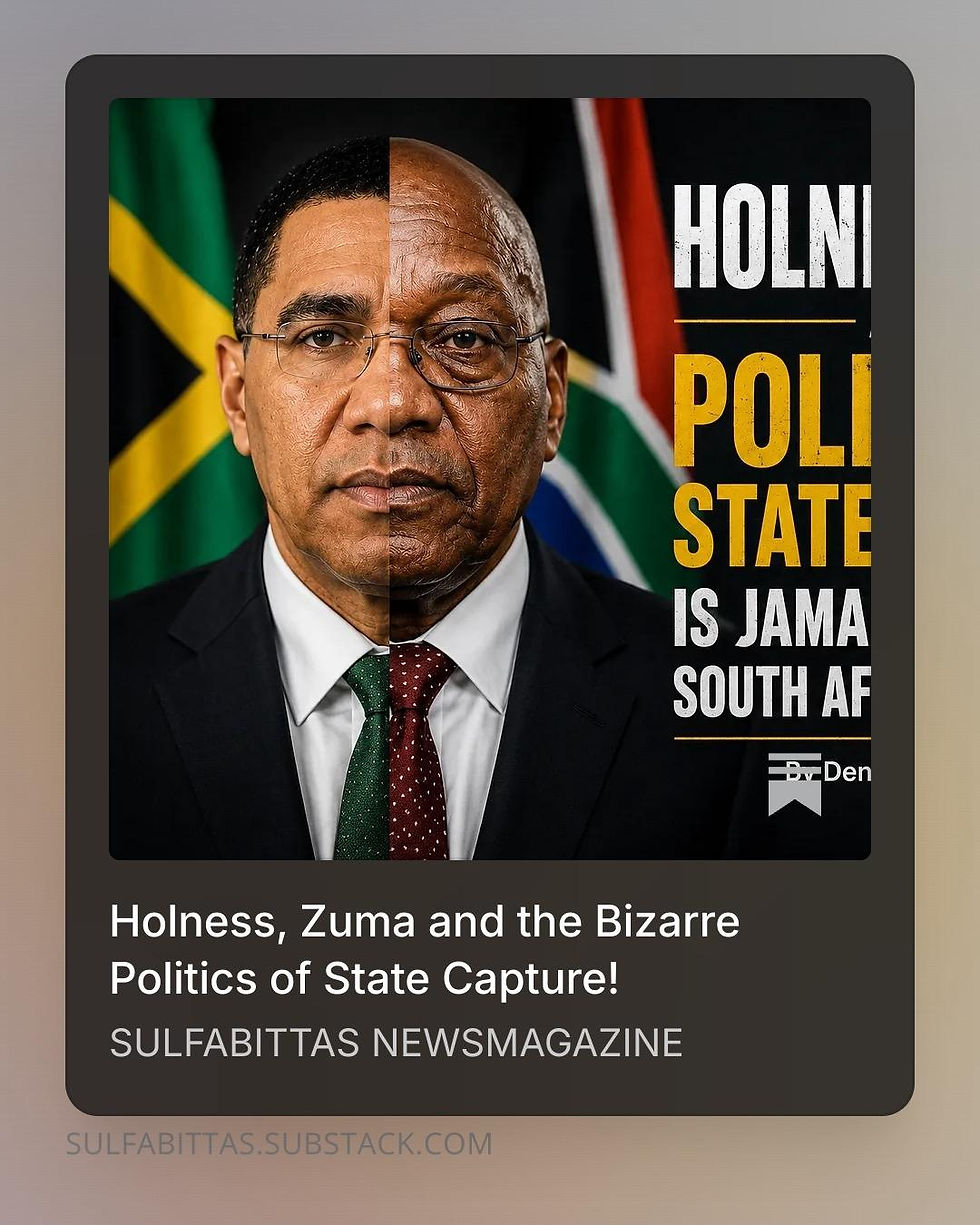
That is how state capture matures.
It rarely arrives as a dramatic coup. It evolves through fatigue. Citizens slowly become accustomed to explanations that once would have shocked them. Supporters increasingly defend behaviour they previously condemned. Oversight agencies become politicised battlegrounds. Courts face mounting pressure. Parliament becomes timid. Public ethics become tribalised.
Eventually the abnormal becomes ordinary.
Jamaicans must understand that democratic decline in the twenty-first century is often psychologically incremental rather than constitutionally sudden.
The third component of this composite animal is disaster-enabled centralisation.
Post-Melissa Jamaica has entered a psychologically vulnerable phase. Populations traumatised by crisis often become more willing to tolerate concentrated executive authority in exchange for promises of order, rebuilding, efficiency, and stability. That pattern has occurred repeatedly across the world.
Crises strengthen executives naturally.
Sometimes necessarily.
But crises also create opportunities for democratic shortcuts, weakened scrutiny, emergency-style governance habits, procurement opacity, accelerated discretionary spending, and a dangerous public belief that “only one man can manage this.”
History warns us repeatedly about this syndrome.
The fourth component is the weakening of institutional courage.
One of the most quietly dangerous developments in Jamaica today is not merely political behaviour itself, but the apparent growing hesitation of institutions to confront executive power aggressively and consistently. Oversight appears increasingly selective. Parliamentary resistance often seems anaemic. Public agencies sometimes communicate with visible caution around politically sensitive matters.
Even sections of civil society appear exhausted.
That exhaustion is politically consequential.
Democracy depends not merely on laws but on institutional confidence. Once institutions begin subconsciously adjusting themselves around executive sensitivities, democratic weakening accelerates dramatically.
And yet many Jamaicans still dismiss these warnings because they expect democratic erosion to resemble old-fashioned dictatorship. They wait for tanks, censorship, cancelled elections, or martial law. Modern democratic decay is subtler than that. Elections continue. Markets function. Hotels expand. Motorways open. Speeches celebrate progress.
Meanwhile accountability slowly suffocates underneath the branding.
That is why the phrase “composite animal” matters.
The danger is not that Holness is identical to Zuma. Jamaica is not South Africa. The scales differ enormously. The histories differ. The institutions differ. But political species analysis still matters because certain governing behaviours share recognisable genetic characteristics across societies.
When oversight becomes personalised warfare;
when watchdogs are portrayed as enemies;
when public transparency becomes negotiable;
when executive authority grows psychologically dominant;
when institutions become hesitant;
when tribal loyalty overwhelms ethical consistency;
when citizens begin accepting explanations they once would have rejected —
a composite democratic predator may already be emerging.
Jamaicans therefore face a profound civic choice.
Will we strengthen institutions now while they still possess credibility and independence?
Or will we wait until democratic erosion becomes undeniable, by which time the institutional muscles required for resistance may already have atrophied?
South Africans asked versions of these questions too late.
Jamaica still has time.
But not unlimited time.


Comments